
Leon Spilliaert: Through Half-Open Doors
Often associated with the Belgian Symbolist movement, Léon Spilliaert (Ostend 1881 – Brussels 1946) is in fact more of a free spirit who refused to introduce any notion of idealism or symbolism into his art. In his early responses to literary texts, deepening their mood, he revisited the representation of women in art, and immersed himself in painful introspection, through a series of strikingly honest self‑portraits. An essentially solitary artist, he let his gaze wander through a very private world that he both experienced and analyzed.
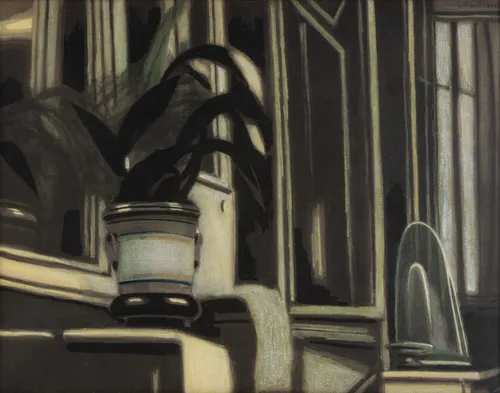
Like many of his contemporaries, he paid close attention to the spaces in which he lived but took the practice much further. He expressed a particular desire to convey a more profound vision of everyday reality. In the footsteps of Xavier Mellery (1845–1903), he sought to give form to animism, attributing a soul to spaces and objects. Invariably, a climate of silence reigns in Spilliaert’s rooms and interiors, devoid of human presence. He isolates them in timeless, fragmentary compositions that reflect a penchant for quasi-photographic viewpoints and unusual angles. Spilliaert uses a variety of different perspectives to create serial motifs, returning to them time and time again; the living- and workspaces within the family home, a fireside corner, a library corner, the conservatory, the silent piano, the burgeoning house plants.
Around 1909, during a period of illness, Spilliaert found new material for plain, simple still-life arrangements in the objects that populated his sickroom. From time to time, with a touch of theatrical exaggeration, he created small, staged ensembles: a carafe, a teapot, a cup, their forms echoing one another, their textures alive with light. But most often, he captured the immutability of objects upon which his lively gaze alights purely by chance, simple bottles and flasks, a seashell, a pair of discarded gloves. In his mind’s eye, these objects take on a life of their own. Spilliaert described this process: sometimes, quite unexpectedly, through a form of intellectual displacement, an item throws off its name, its objective meaning, and reveals itself in new and striking ways — an image dissolved by a state of consciousness that borders on the surreal. In this sense, Spilliaert stands at the dawn of a new modernity.
Spilliaert never subverts the viewer’s reading of the reality of the things he portrays. His rigorously simplified, pared-down compositions, and the enigmatic play of shadows are highly evocative. Through his handling of the medium — supple washes of liquid ink, occasional touches of color — he transforms objects and strips them of their material essence. Their outlines remain, but emptied of substance, they are imbued with spiritual significance. In his constant quest for the reality of beings and objects, Léon Spilliaert saw the potential of these fleeting transformations and strove to capture their transcendental quality.